
Sophora japonica — the Japanese pagoda tree — has supplied botanical medicine for centuries. Today its dried flower bud is one of the world’s leading commercial sources of two flavonoids: rutin and quercetin. Both appear widely in dietary supplements, functional foods, and pharmaceutical intermediates. This article explains what Sophora Japonica Extract is, how suppliers standardize it, and how buyers choose between its two main grades.
A Single Botanical, Two Standardized Products
The tree now known as Styphnolobium japonicum once carried the name Sophora japonica L.[1] The United States Pharmacopeia recognizes its dried flower bud as “Japanese Sophora Flower Bud”[1] and treats the open flower as a separate botanical.[2] The flower bud is known in Chinese as huaimi. It carries more flavonol glycosides than the open flower, which is why it remains the preferred raw material for extraction.[1][2]
Rutin and Quercetin: One Sugar Group Makes the Difference
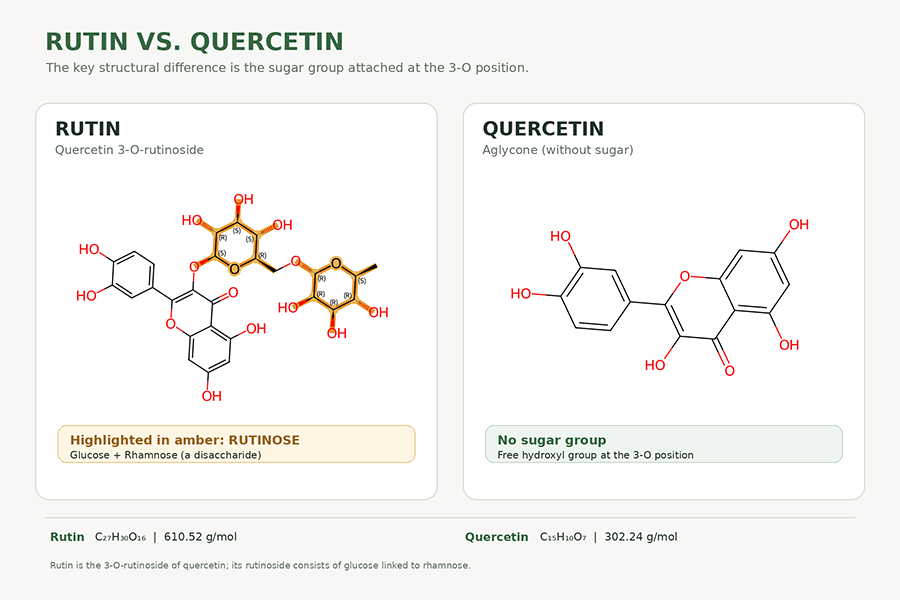
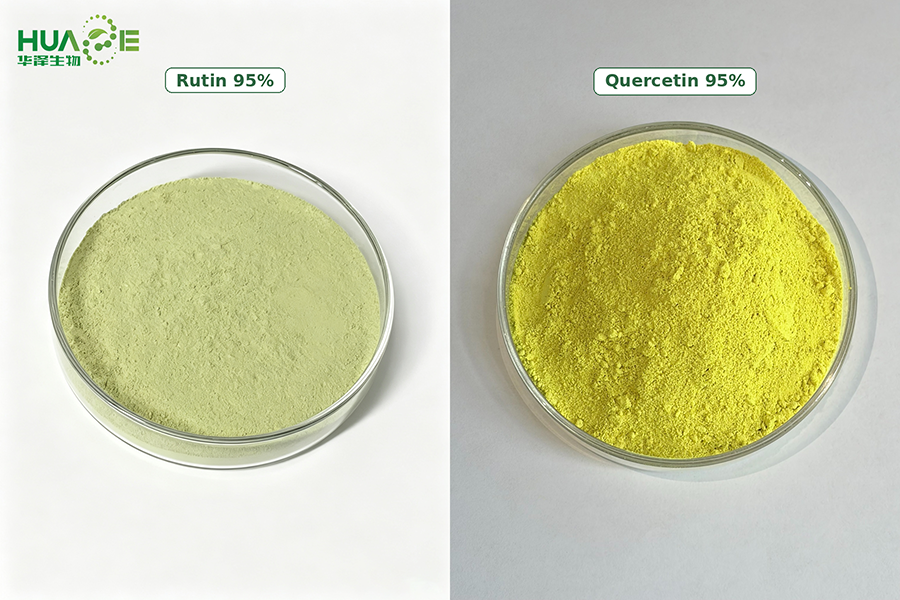
Sophora japonica flower buds are rich in flavonol glycosides, with rutin as the dominant compound.[4] Rutin is a glycoside of quercetin — specifically quercetin-3-O-rutinoside. Quercetin, in contrast, is the aglycone, the flavonol without its sugar group. This single chemical difference explains why one plant yields two distinct products. In short, it offers a rutin 95% grade and a quercetin 95% grade.
Standardization and Quality
In commercial practice, suppliers standardize Sophora Japonica Extract to a declared marker — most often rutin or quercetin — and assay it by HPLC.[5] The USP monograph for the dry extract does not set a fixed 95% level. Instead, it requires the labeled rutin and total flavonol glycosides to fall within 90% to 110% of claim.[3] For this reason, a credible COA should state the assay method, the plant part, and the dry-basis calculation.
Sophora Japonica Benefits and the Evidence
Sophora japonica benefits appear throughout traditional medicine and modern research. A review of its traditional uses and phytochemistry documents applications across several plant parts. The flower and flower bud are most relevant to flavonoid content.[4] One sophora flower benefit commonly cited is its role in vascular and capillary-support formulas, reflecting the antioxidant activity of rutin and quercetin.[6] However, most supporting
studies use in vitro or animal models. For example, a murine colitis study examined sophora japonica flower extracts and rutin.[7] Buyers should therefore treat these findings as research background rather than human clinical proof.
Safety
A 2022 safety review written with USP participation found no serious adverse events in the studies it examined, while noting that pregnancy and lactation data remain limited.[8] This supports a cautious safety profile, but it does not replace finished-product regulatory review.
Applications
Sophora Japonica Extract and its two flavonoids serve many finished product categories. Rutin 95% fits vascular, capillary, and eye-health formulas, and it also acts as a precursor for troxerutin synthesis. Quercetin 95%, the aglycone, suits immune, respiratory, and anti-aging products. Both grades work in capsules, tablets, and functional powders.
Choosing Between Rutin 95% and Quercetin 95%
The choice depends on the finished product. Rutin 95% suits stable, glycoside-based formulations, while quercetin 95% offers a more direct antioxidant profile. Because both derive from the same flower bud, sourcing them together can simplify supply and documentation.
Conclusion
Sophora Japonica Extract shows how one botanical can support two standardized ingredients. Buyers can source with confidence. They simply need to understand the rutin–quercetin relationship, the USP framework, and the limits of the evidence.
References
[1] USP-NF. Japanese Sophora Flower Bud. United States Pharmacopeia–National Formulary.
[2] USP-NF. Japanese Sophora Flower. United States Pharmacopeia–National Formulary.
[3] USP-NF. Japanese Sophora Flower Dry Extract. United States Pharmacopeia–National Formulary.
[4] Local and traditional uses, phytochemistry, and pharmacology of Sophora japonica L.: A review. Journal of Ethnopharmacology. 2016.
[5] HPLC Determination of Rutin Content in Japanese Sophora Buds. Pharmaceutical Chemistry Journal. 2025.
[6] Effects of Roasting on Antibacterial and Antioxidant Properties of Sophora japonica Buds — The Involvements of Rutin and Quercetin Constituents. Plants (Basel). 2024.
[7] Sophora japonica flowers and their main phytochemical, rutin, regulate chemically induced murine colitis. Food Chemistry. 2022.
[8] United States Pharmacopeia comprehensive safety review of Styphnolobium japonicum flower and flower bud. Phytotherapy Research. 2022.