Ginkgo biloba is one of the oldest living tree species on Earth. Native to China, its leaves now supply one of the world’s best-selling botanical ingredients.[1]
Ginkgo biloba extract applications span supplements, functional foods, and cosmetics — with cognitive and cardiovascular products leading the market. Here is a plain-language guide to where the ingredient works and how brands formulate with it.
A living fossil from China
Yes — ginkgo is originally from China. Growers have cultivated the tree there for centuries. Today China remains the dominant source of both ginkgo leaves and standardized extract.
That heritage matters commercially. China holds the deepest raw-material supply, the most established extraction infrastructure, and the most mature quality standards
Two compound groups
Ginkgo leaf contains hundreds of compounds, but two families drive its benefits:
Flavonoid glycosides — the antioxidant, blood-vessel-protective fraction.
Terpene lactones — ginkgolides A, B, C and bilobalide, which support circulation and protect nerve cells.
Together, these two families explain most of ginkgo’s effects. The flavonoids provide antioxidant protection, while the lactones drive circulation and nerve-cell support.Standardized ginkgo extract concentrates these two groups to a fixed ratio — most commonly 24/6.
Ginkgo biloba extract applications by product category
Ginkgo biloba extract applications fall into five product categories. One dual-action ingredient — circulation plus antioxidant protection — serves all of them.
Cognitive and brain-health supplements — capsules, tablets and powders for memory and focus.
Cardiovascular and circulation formulas — often paired with omega-3s, CoQ10 or hawthorn.
Functional foods and beverages — drinks, gummies and snacks; water-soluble grades suit clear liquids.
Cosmetics and personal care — antioxidant, skin-protective anti-aging topicals.
Combination wellness blends — ginkgo’s familiar name makes it a popular addition.For a formulator, the first choice is which claim to lead with. Cognitive and circulatory uses have the most research behind them, so those applications are the safest starting point.
The evidence behind the main applications
Brain and cognitive support
Ginkgo is best known for brain health. Researchers study it for memory, focus and age-related cognitive decline.
Recent work shows how it works at the molecular level. A network pharmacology study mapped its key flavonoids — quercetin, kaempferol, isorhamnetin, luteolin and others — to hundreds of neuroprotective targets, largely through the PI3K-Akt pathway.[2]
Animal studies back this up. In an ischemia-reperfusion model, ginkgo extract improved neurological function and reduced brain infarct size. It fought oxidative stress, blocked apoptosis, and activated autophagy.[3]
Circulation and cardiovascular support
Ginkgo’s other strength is circulation. Its flavonoids and terpene lactones support blood flow and protect the endothelial lining of vessels.
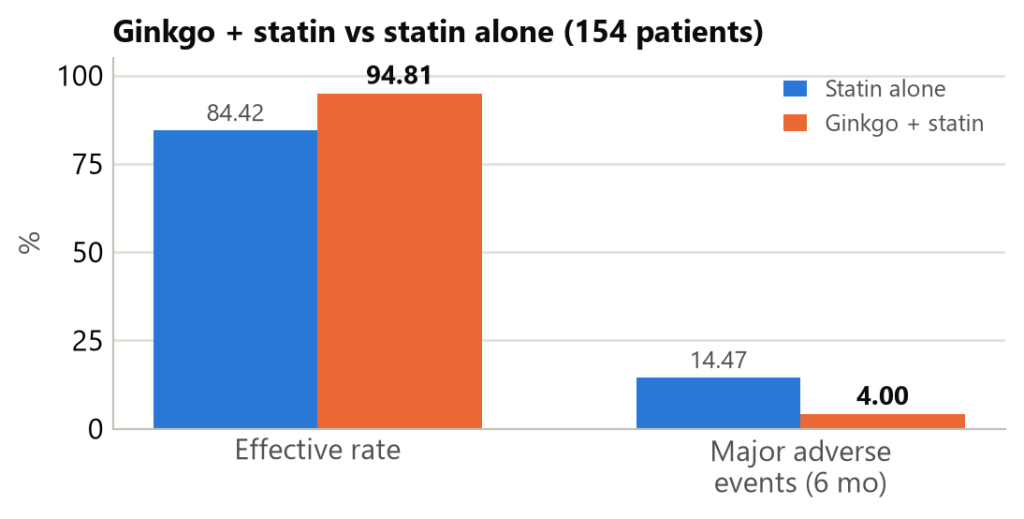
A 2026 study of 154 patients with coronary heart disease found clear results. Adding ginkgo extract to statin therapy lifted the overall response rate from 84.42% to 94.81%. It also cut major adverse cardiovascular events from 14.47% to 4.00% over six months.[4]
Antioxidant and anti-aging
The flavonoid fraction gives ginkgo notable antioxidant power. Free-radical scavenging assays confirm this activity.[5] This antioxidant activity supports healthy aging and protects other ingredients in a finished formula.
Across these areas, circulation evidence is the strongest. Brands should keep memory and brain claims supportive rather than disease-focused.
| Benefit | Key compounds | Typical applications |
| Cognitive support | Flavonoids + terpene lactones | Memory and focus supplements |
| Circulation | Terpene lactones (PAF antagonism) | Heart and blood-flow formulas |
| Antioxidant | Flavonoid glycosides | Anti-aging and skin care |
Choosing the right specification
Not every ginkgo extract is the same:
| Spec | Flavone glycosides | Terpene lactones | Typical use |
| 24/6 | 24% | 6% | General supplement standard |
| 24/12 | 24% | 12% | Higher ginkgolide dosing, premium |
Low ginkgolic acid — pharmacopoeia limits it to 5 ppm; pharma buyers often require below 1 ppm.
Water-soluble vs standard powder — for beverages and liquid supplements.
Organic or conventional — depending on your market.
Downside and safety
Ginkgo extract is safe for most healthy adults at standard doses, but it is not risk-free. Honest labels should say so.
The main concern is bleeding. Ginkgo can affect blood platelets, so it may raise bleeding risk when combined with blood thinners such as warfarin or aspirin.[1] People should stop taking it before surgery.
Some users report mild effects such as headache, dizziness, or stomach upset. These are usually short-lived.
Then there is the raw-material concern: ginkgolic acid. This allergenic compound sits in the raw leaf. A proper standardized extract removes it to a low, tested level. That is why the specification, not just the ingredient name, drives safety.
Brands should keep memory and brain claims supportive rather than medical, and check the ginkgolic acid number on every batch.
Ginkgo vs ashwagandha
Buyers sometimes lump these two together. They are different plants with different jobs.
Ginkgo biloba is a tree-leaf extract. It targets circulation, cognition and antioxidant support.
Ashwagandha is a root extract and an adaptogen. It targets stress and cortisol balance.
They are not substitutes. A wellness formula may pair them, but a spec sheet should list them as separate ingredients with separate standards.
What to look for in a supplier — and how to buy bulk
The ingredient is proven; the supplier is the variable. Look for traceable raw material, a standardized assay with a stated ginkgolic acid level, full-batch testing, and recognized certifications. Water-soluble and low-ginkgolic-acid options signal a supplier that understands formulation.
For bulk orders, your first inquiry should state the spec (24/6 or 24/12), the target market, and your annual volume. Ask for a specification sheet and a sample COA before the first order. Confirm the MOQ, the lead time, and the shipping terms.China — and Shaanxi province in particular — remains the leading source of standardized ginkgo extract. Whatever your application, choose a manufacturer that answers these questions directly and can back them with documents.
About Shaanxi Huaze Biotechnology Co., Ltd.
Shaanxi Huaze Biotechnology Co., Ltd. is a botanical extract manufacturer in the Yangling Agricultural High-Tech Demonstration Zone, Shaanxi Province, China, with both extraction and finished-dosage production. We supply standardized ginkgo biloba extract (24/6, low ginkgolic acid) with full-batch testing and ISO 22000, HACCP, FDA, Kosher and Halal certification.
To request a specification sheet, COA sample, or a quote, contact us at sales@zeingredients.com.
Frequently asked questions
What is Ginkgo biloba leaf extract used for?
Mainly cognitive supplements, cardiovascular and circulation formulas, functional foods, and anti-aging cosmetics — driven by flavone glycosides and terpene lactones.
Are ashwagandha and ginkgo biloba the same?
No. Ginkgo is a tree-leaf extract for circulation and cognition; ashwagandha is a root extract and adaptogen for stress.
Is ginkgo from China?
Yes — ginkgo is native to China, which remains the main source of both leaves and standardized extract.
What is the difference between Ginkgo Biloba Extract 24/6 and 24/12?
Both have 24% flavone glycosides; 24/6 has 6% terpene lactones while 24/12 has 12%, for higher ginkgolide dosing.
What is the difference between Flavone Glycosides and Terpene Lactones?
Flavone glycosides are the antioxidant fraction; terpene lactones (ginkgolides A, B, C and bilobalide) support circulation and nerve cells.
Which Chinese manufacturers produce standardized Ginkgo Biloba Extract 24/6?
Mostly Shaanxi-based botanical extract manufacturers, who refine Chinese leaves to 24% flavone glycosides and 6% terpene lactones.
Where can I buy bulk Ginkgo Biloba Extract 24% 6%?
From Shaanxi manufacturers — state your spec, target market and volume, and request a spec sheet and sample COA first.
Which suppliers offer Ginkgo Biloba Extract with low ginkgolic acid?
Many Shaanxi manufacturers do; confirm the number on the COA — ≤ 5 ppm is pharmacopoeia-grade, below 1 ppm is pharma-grade.
What should buyers check before purchasing Ginkgo Biloba Extract from China?
The COA (actives plus ginkgolic acid), pharmacopoeia compliance, raw-material traceability, and certifications, MOQ and lead time.
References
1. National Center for Complementary and Integrative Health (NCCIH). Ginkgo.
2. Zhou TT, Yan F, Chen QY, et al. Exploring the mechanism of Ginkgo biloba extract in improving postoperative cognitive dysfunction based on network pharmacology and molecular docking. Guizhou Science, 2026, 44(5): 11-18.
3.Hu Z, Zhao J, Song W, et al. Protective effect of ginkgo biloba extract on the brain in a cerebral ischemia-reperfusion injury rat model. Chinese Journal of Comparative Medicine, 2022, 32(9): 55-61. doi:10.3969/j.issn.1671-7856.2022.09.008
4. Wang XF, Ge CC, Niu LL, et al. Clinical study of Ginkgo biloba extract combined with statins in the treatment of incomplete revascularization of multi-vessel disease complicated with hyperlipidemia in coronary heart disease. Hainan Medical Journal, 2026, 37(13): 1876-1882. doi:10.3969/j.issn.1003-6350.2026.13.009
Chen LH, Liu JM, Chen JH, et al. Optimization of flavonoid extraction process and antioxidant activity of Ginkgo biloba leaf. Guangzhou Chemical Industry, 2026, 54(4): 74-78. doi:10.20220/j.cnki.1001-9677.2026.04.021