Ginkgo biloba extract 24/6 — 24% flavone glycosides plus 6% terpene lactones — is the supplement industry’s default grade. Yet two suppliers quoting the same 24/6 can ship very different products.
The difference is rarely the final number. It lies in the raw leaf, the extraction route, and one safety parameter many buyers miss: residual ginkgolic acid. China dominates this market, and most standardized ginkgo still comes from Shaanxi manufacturers. This guide explains how manufacturers make 24/6 and what to check before you buy.
What “24/6” means
A standardized extract is not a simple leaf powder. It is a concentrate with a guaranteed active content.
24% refers to total flavone glycosides — the antioxidant, vascular-protective fraction.
6% refers to total terpene lactones — ginkgolides A, B, C and bilobalide, which support circulation and neuroprotection.
For a buyer, the number is a guarantee. It means every batch meets the same potency, no matter where or when the leaves grew. Chinese manufacturers — most of them in Shaanxi — produce the bulk of the world’s standardized ginkgo, so the 24/6 grade is widely available. The real question is which suppliers hold the number honestly.
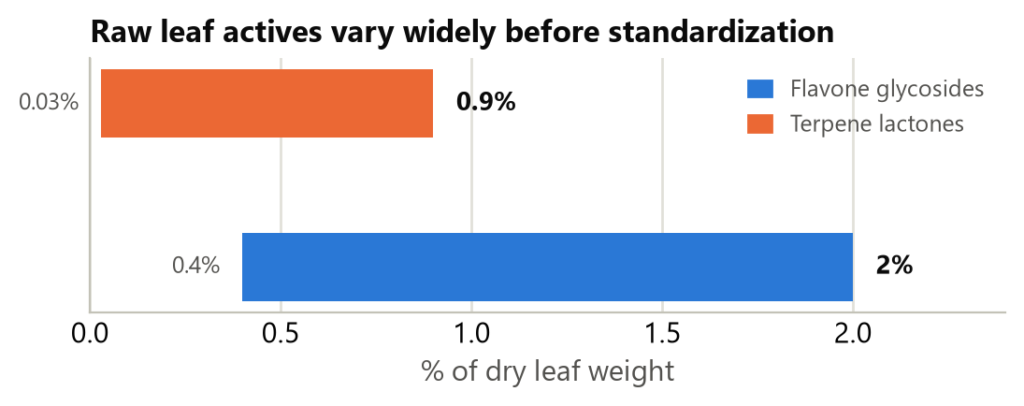
Standardization matters because raw leaf chemistry varies. Flavone glycosides range from roughly 0.4% to over 2%, and terpene lactones from about 0.03% to 0.9%.[1] Making a consistent 24/6 product is therefore an achievement, not a given.
Quality starts with the leaf
No process can fix poor raw material. Where and when growers harvest the leaf drives its chemistry.
A study of 99 batches from six major Chinese planting bases found clear patterns:[1]
| Factor | Finding |
| Origin & altitude | High-altitude regions (Yunnan Wenshan, Shaanxi Ningqiang) held more actives |
| Tree age | Younger trees produced richer leaves |
| Harvest time | The best window shifts by latitude |
For a buyer, this becomes one question: does the manufacturer control its leaf source, or buy opportunistically? Traceable, high-altitude, well-timed leaf is the foundation of a reliable 24/6 extract.
Extraction: pulling out the actives
Manufacturers extract the leaves with an ethanol–water solvent. This solvent dissolves both active fractions efficiently.
Typical optimized parameters include:[2,3]
60% ethanol as the solvent;
heated extraction near 70 °C (or ultrasonic-assisted at ~40 °C);
a solid-to-liquid ratio around 1:10 to 1:25;
two or more extraction passes.
Typical optimized parameters include:[2,3]
60% ethanol as the solvent;
heated extraction near 70 °C (or ultrasonic-assisted at ~40 °C);
a solid-to-liquid ratio around 1:10 to 1:25;
two or more extraction passes.
After extraction, the crude concentrate is still too dilute and carries unwanted components. Macroporous resin columns purify it. The resins retain the flavonoids and terpene lactones while sugars and pigments wash through.
One production insight matters: a single resin rarely optimizes both actives at once. Modern processes therefore use mixed resin systems — for example, HPD417 plus DM130 in a 1:2 ratio.[2] This balances flavone and lactone recovery and cuts production cost.
| Step | What happens | Why it matters |
| Extraction | Ethanol–water pulls out the actives | Recovers both active fractions |
| Resin purification | Mixed resin (HPD417:DM130) enriches the actives | Balances flavonoid and lactone yield |
| Deacidification | LX-60 resin strips ginkgolic acid | Lowers the allergenic compound to trace levels |
| Standardization | Adjusts to the 24/6 ratio | Keeps every batch consistent |
Deacidification: the safety step buyers overlook
Ginkgo leaves contain ginkgolic acid, an allergenic and cytotoxic alkylphenol. A proper extract removes it to trace levels.
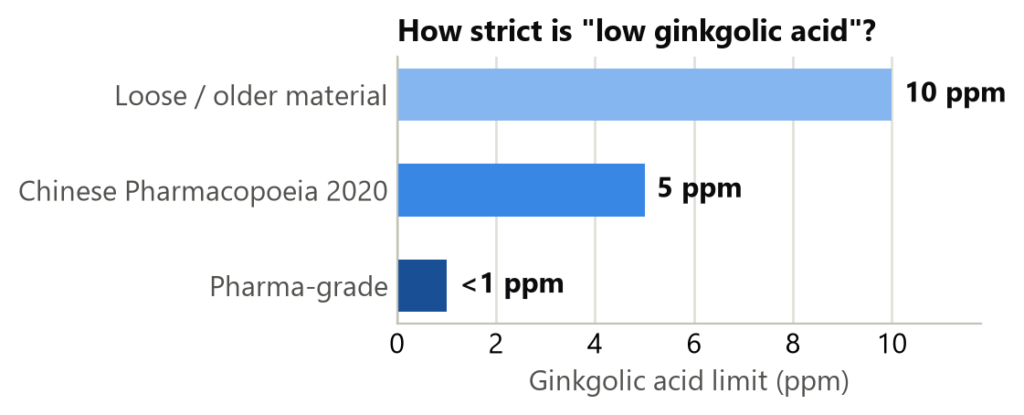
The Chinese Pharmacopoeia (2020) sets the limit at 5 mg/kg (5 ppm).[4] Many buyers now require below 1 ppm. Deacidification is a dedicated step, often an LX-60 resin pass.[2] Ginkgolic acid can irritate the skin and trigger allergic reactions, so even small residues matter in safety-conscious markets. If a COA does not state a ginkgolic acid value, treat that as a red flag.
5 ppm vs 10 ppm: why the number matters
Some older or lower-grade material is still sold against a 10 ppm — or looser — limit. The difference is not cosmetic.
5 ppm is the Chinese Pharmacopoeia 2020 limit.[4] It is the baseline for a modern extract.
Below 1 ppm is what pharmaceutical and safety-conscious buyers now request.
10 ppm or higher usually signals weak deacidification or an unstandardized leaf powder.
For topical products, long-term daily use, or markets with strict allergen rules, choose the lower number. When a supplier says “low ginkgolic acid,” ask for the number — not the label.
Standardization and testing
Once purified, the manufacturer standardizes the extract and tests it. A credible COA for 24/6 should list:
| Test | Method | Typical spec |
| Total flavone glycosides | HPLC | ≥24% |
| Total terpene lactones | HPLC | ≥6% |
| Ginkgolic acid | HPLC | ≤5 ppm (or <1 ppm) |
| Heavy metals | ICP-MS / AAS | Pharmacopoeia limits |
| Residual solvents | GC | Pharmacopoeia limits |
| Microbiology | Plate count | Pharmacopoeia limits |
“Full batch testing” means the supplier tests every production batch, not occasional samples. Many brands also request a third-party lab report to cross-check the supplier’s COA.
A buyer’s checklist
Before you order, ask your supplier to confirm:
1. COA with a ginkgolic acid value — always.
2. Pharmacopoeia compliance — Chinese Pharmacopoeia 2020, and USP/EP where relevant.
3. Traceable raw material — origin, tree age, and harvest window.
4. Certifications — food-safety and market-access credentials.
5. Form options — standard powder, water-soluble, or low-ginkgolic-acid grades.
Verifying a batch before you pay
A quote is only as good as the documents behind it. Before a first order, request three things:
1. A specification sheet that states flavone glycosides, terpene lactones, and ginkgolic acid.
2. A sample COA from the most recent production batch.
3. A pharmacopoeia method reference for each test.
Also confirm the MOQ, the lead time, and whether the supplier ships from stock or makes to order. Ask whether water-soluble and low-ginkgolic-acid grades are available. A manufacturer that hesitates to share these documents is not ready for a serious buyer.
About Shaanxi Huaze Biotechnology Co., Ltd.
Shaanxi Huaze Biotechnology Co., Ltd. manufactures botanical extracts at a 25,000 m² facility in the Yangling Agricultural High-Tech Demonstration Zone. The company holds ISO 22000, HACCP, US FDA registration, Kosher and Halal certifications.
We standardize our ginkgo biloba extract to 24/6, with low-ginkgolic-acid options. We test every batch in full before shipment — the same practice this guide tells buyers to look for.
To check a batch for yourself, request a specification sheet and a sample COA at sales@zeingredients.com.
References
1. Shi FJ, Yang CJ, Chen XF, et al. Effect of origin, tree age, and harvesting time on content of flavonoids and terpene lactones in Ginkgo Folium. China Journal of Chinese Materia Medica, 2022, 47(15): 4055. doi:10.19540/j.cnki.cjcmm.20220417.103
2. Yang XB, Chen W, Chen Z, et al. Process optimization of Ginkgo leaf extraction. Guangzhou Chemical Industry, 2026, 54(12): 80-84. doi:10.20220/j.cnki.1001-9677.2026.12.020
3. Chen LH, Liu JM, Chen JH, et al. Optimization of flavonoid extraction process and antioxidant activity of Ginkgo biloba leaf. Guangzhou Chemical Industry, 2026, 54(4): 74-78. doi:10.20220/j.cnki.1001-9677.2026.04.021
4. Chinese Pharmacopoeia Commission. Pharmacopoeia of the People’s Republic of China (2020 ed., Vol. I). Beijing: China Medical Science Press, 2020.